
NanoVNA Series by NanoRFE
The original, high-performance NanoVNA series designed by NanoRFE.
Whether you are tuning a Ham Radio antenna, designing WiFi 6 filters, or performing laboratory RF research, our handheld Vector Network Analyzers provide professional-grade accuracy from 50kHz up to 6GHz.
- Official Hardware: Original S-A-A-2 and VNA6000 architectures.
- Superior Range: Precision measurements up to 6GHz with 110dB dynamic range.
- Trusted Globally: The industry standard for hobbyists and RF engineers alike.
What is a NanoVNA?
The NanoVNA is a compact, handheld Vector Network Analyzer. Unlike a simple SWR analyzer, it measures both the magnitude and phase of RF signals, allowing you to view Smith Charts, measure filter loss, and tune complex antenna systems from 50kHz up to 4GHz or 6GHz (depending on the model).
Key Applications
Measure SWR, Return Loss, and Impedance for Ham Radio, WiFi, and IoT deployments.
Characterize Bandpass filters, attenuators, and amplifiers with up to 110dB dynamic range.
Locate cable faults and measure cable length/velocity factor with precision TDR features.
The NanoVNA has become the most popular Amateur Radio antenna analyzer due to its portability and Smith Chart capabilities.
Common Measurements with NanoVNA:
- SWR & Return Loss (Antenna Tuning)
- Smith Chart (Impedance Matching)
- Filter Characterization (Bandpass/Notch)
- Coax Cable Loss (Insertion Loss)
- Cable Length (via TDR)
- Crystal/Resonator testing
Which NanoVNA should I buy?
- The Amateur Radio Operator: If you are tuning HF, VHF, or UHF antennas, the NanoVNA V2 Plus4 is the gold standard. It offers the best balance of price and performance for SWR and Smith Chart analysis.
- The WiFi & IoT Developer: For those working on 2.4GHz or 5.8GHz ISM bands, the VNA6000-A is required to reach the 6GHz range with high accuracy.
- The Professional RF Lab: The VNA6000-B features a custom architecture with 110dB dynamic range, making it a portable alternative to expensive desktop VNAs for filter characterization.
The NanoRFE Performance Advantage
While clones look similar on the outside, the internal circuitry is vastly different. NanoRFE devices offer:
- High-Isolation Shielding: Prevents crosstalk and ensures a stable noise floor.
- High-Linearity Mixers: Avoids compression artifacts common in low-cost copies.
- Official Software Support: Guaranteed compatibility with NanoVNA-QT for automated data export.
Compare NanoVNA Models
Compare the specifications of the official NanoVNA V2 and V3 (VNA6000) series to find the right instrument for your RF lab.
| Series / Model |
Frequency Range |
Dynamic Range |
Shielding | Key Features |
|---|---|---|---|---|
| NanoVNA V2 Series (S-A-A-2 Architecture) | ||||
| NanoVNA V2 Plus4 | 50k - 4.4GHz | 90dB | Full metal shielding | Standard professional model; high-speed USB interface. |
| NanoVNA V2 Plus4 Pro | 50k - 4.4GHz | 90dB | Full metal shielding | Adjustable IFBW; enhanced temperature stability; reduced trace noise for precision lab work. |
| NanoVNA V3 Series (VNA6000 Architecture) | ||||
| VNA6000-A | 50k - 6GHz | 95dB | Inner & outer |
Optimized for WiFi 6 and 5.8GHz ISM band applications. |
| VNA6000-B | 50k - 6GHz | 110dB | Inner & outer EMI Shielding | Flagship Model: Highest dynamic range; custom low-noise architecture; professional laboratory performance. |
| Generic NanoVNA Clones (V1, NanoVNA-H, H4) | ||||
| Generic NanoVNA | 300MHz (fundamental) 900MHz (harmonics) |
~30dB | Unshielded | High trace noise, usable for very basic HF/VHF Tuning |
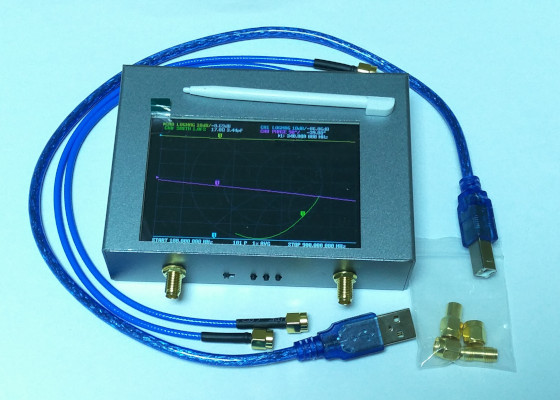
NanoVNA V2 Series
The industry-standard 4.4GHz analyzer. Perfect for tuning antennas, measuring filters, and duplexers.
NanoVNA V2 Technical Specifications ▸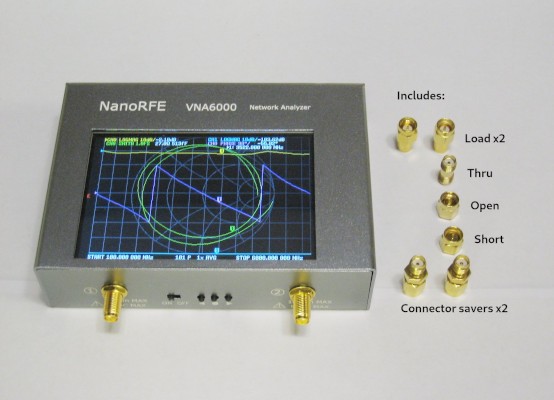
VNA6000 Series
Next-generation architecture featuring lower trace noise and high dynamic range up to 6GHz.
VNA6000 Technical Specifications ▸Proven Accuracy: Professional VNA Comparisons
The NanoVNA series by NanoRFE is the only low-cost analyzer platform that delivers repeatable results comparable to industry-standard laboratory instruments.
vs. Keysight FieldFox
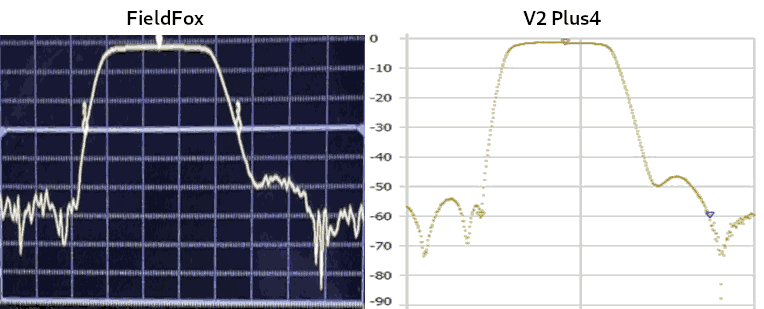
Independent testing by AE5X demonstrates professional-grade dynamic range and linearity from 1GHz to 3GHz.
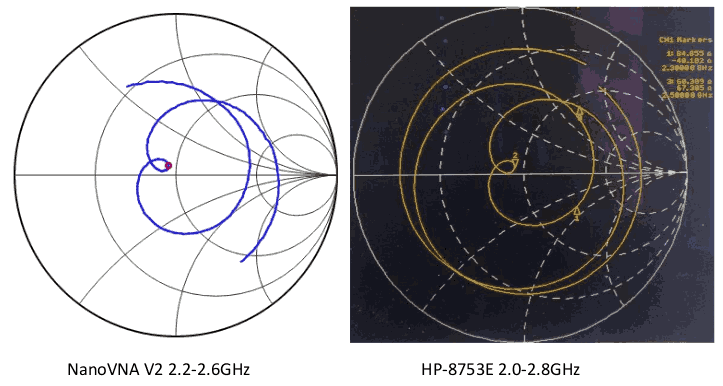
Precision Measurements Without Harmonics
Unlike legacy NanoVNA clones that use harmonics to exaggerate their frequency range (leading to noisy and often incorrect measurements), the V2 Plus4 and VNA6000 use fundamental frequencies across their entire range.
- 90dB+ Dynamic Range: Measure high-rejection filters and duplexers with confidence.
- Temperature Drift Cancellation: Our VNA-R architecture ensures your calibration remains valid for months, not minutes.
- High Trace Stability: Achieve 90% less trace noise than generic variants.
NanoVNA Resources & Getting Started
For Beginners
Professional SOLT Calibration
To ensure laboratory-grade accuracy, all NanoRFE devices support SOLT (Short, Open, Load, Through) calibration. Every official kit includes precision SMA calibration standards. Calibrating your NanoVNA removes the effects of cables and adapters, moving the "reference plane" directly to your device under test (DUT).
Official NanoVNA Software: VNA View
Connect your NanoVNA to your PC or Mac via USB to unlock advanced features. Use the official NanoVNA-QT (VNA View) software for real-time data export, or the community-favorite NanoVNA Saver for high-resolution sweeps and remote control.
Getting Started with your NanoVNA
1. Set Range: Define your Start and Stop frequencies (e.g., 140MHz to 150MHz for 2m Ham Radio).
2. Calibrate: Always perform a SOLT calibration (Short, Open, Load, Through) before measuring.
3. Connect: Attach your antenna or device to Port 1 (S11) to measure SWR or Port 2 (S21) for filter loss.
NanoVNA Frequently Asked Questions
Q: Is the NanoVNA V2 a good antenna analyzer?
A: Yes. Unlike basic SWR meters, the NanoVNA measures complex impedance (magnitude and phase), allowing you to see exactly why an antenna is out of tune using a Smith Chart.
Q: What is the difference between NanoVNA-H and NanoVNA V2?
A: The NanoVNA-H is based on the legacy 300MHz design (reaching 900MHz with harmonics) and we no longer sell it. The NanoVNA V2 (S-A-A-2) is our completely new architecture designed for 4GHz+ with significantly higher dynamic range and better shielding.
The Evolution of NanoVNA
The NanoVNA project has moved far beyond the original 2019 edy555 design. Below is the official roadmap of hardware generations.
Generation 1 (Legacy)
Models: NanoVNA-H, H4 (edy555)
Frequency: 300MHz (900MHz harmonics)
Status: Discontinued / Outdated
Uses discontinued SA612 mixers. Limited accuracy above 300MHz.
Generation 2 (Standard)
Models: NanoVNA V2 Plus4 / Pro
Frequency: 4.4GHz (Fundamental)
Status: Actively Supported
New S-A-A-2 architecture with 90dB dynamic range.
Generation 3 (Next-Gen)
Models: VNA6000 Series
Frequency: 6GHz (Professional)
Status: Current Flagship
Laboratory grade accuracy in a handheld form factor.
NanoVNA History
-
2019: The edy555 NanoVNA-H
The history of the NanoVNA began with a portable 50kHz-300MHz analyzer based on a simple 1-stage SA612A mixer architecture, utilizing harmonics to reach up to 900MHz. As widely documented by the amateur radio community, the original NanoVNA was designed by edy555, a Ham located in Japan who took an existing concept from a couple of Texas Hams, developed sophisticated software, and created the first NanoVNA kit. The project was entirely open-sourced, which paved the way for popular mass-produced variants like the NanoVNA-H, H4, and F. While these legacy V1 designs (and their countless marketplace clones) successfully popularized the instrument for hobbyists, their reliance on harmonics to reach 900MHz, audio codecs, and a lack of shielding severely limited their dynamic range and high frequency accuracy. -
2020: NanoRFE & the NanoVNA V2 (S-A-A-2)
To overcome the hardware limitations of the V1, the project required a completely new approach. NanoRFE was established as the official continuation of the NanoVNA project, founded by original NanoVNA developers alongside a dedicated team of RF hardware engineers. Our goal was to bring reliable, lab-grade high-frequency measurements to the masses. The newly formed NanoRFE team designed the NanoVNA V2 (S-A-A-2) entirely from scratch. Sharing zero hardware lineage with the V1, the V2 utilized an ADF4350 synthesizer and AD8342 mixer to expand fundamental measurements up to 3GHz.
Note on Clones: Early V2.2 designs were open-sourced, but were quickly exploited by aggressive clone manufacturers who used unshielded, low-grade parts. To protect the integrity of the instrument and ensure users received accurate RF tools, NanoRFE transitioned to proprietary designs. Today, the official NanoVNA V2 Plus4 remains the only version featuring the original developers' strict shielding, calibration, and firmware optimizations. -
2022: The V2 Plus4 & Plus4 Pro
NanoRFE achieved a major industry breakthrough with the release of the V2 Plus4, reaching a genuine 90dB dynamic range. By engineering a proprietary switched RF bridge architecture (VNA-R) and introducing adjustable IFBW (Intermediate Frequency Bandwidth), we drastically reduced the noise floor. These models became the gold standard for satellite communications, duplexer tuning, and professional RF engineering, offering lab-grade precision in a handheld format. -
2024+: The VNA6000 Series (Next Gen)
The VNA6000 (NanoVNA V3) represents a leap into professional-tier RF instrumentation. Featuring a completely new architecture with a focus on shielding of every sub-module, it eliminates the RF leakage issues of earlier designs. This allows for precise measurements of narrowband devices and high-rejection filters across a 50kHz to 6GHz range. With a flagship 110dB dynamic range and built-in temperature compensation, the VNA6000 delivers lab-grade performance in a 300g handheld form factor. Ideal for WiFi 6, 5.8GHz ISM bands, and advanced RF research.